


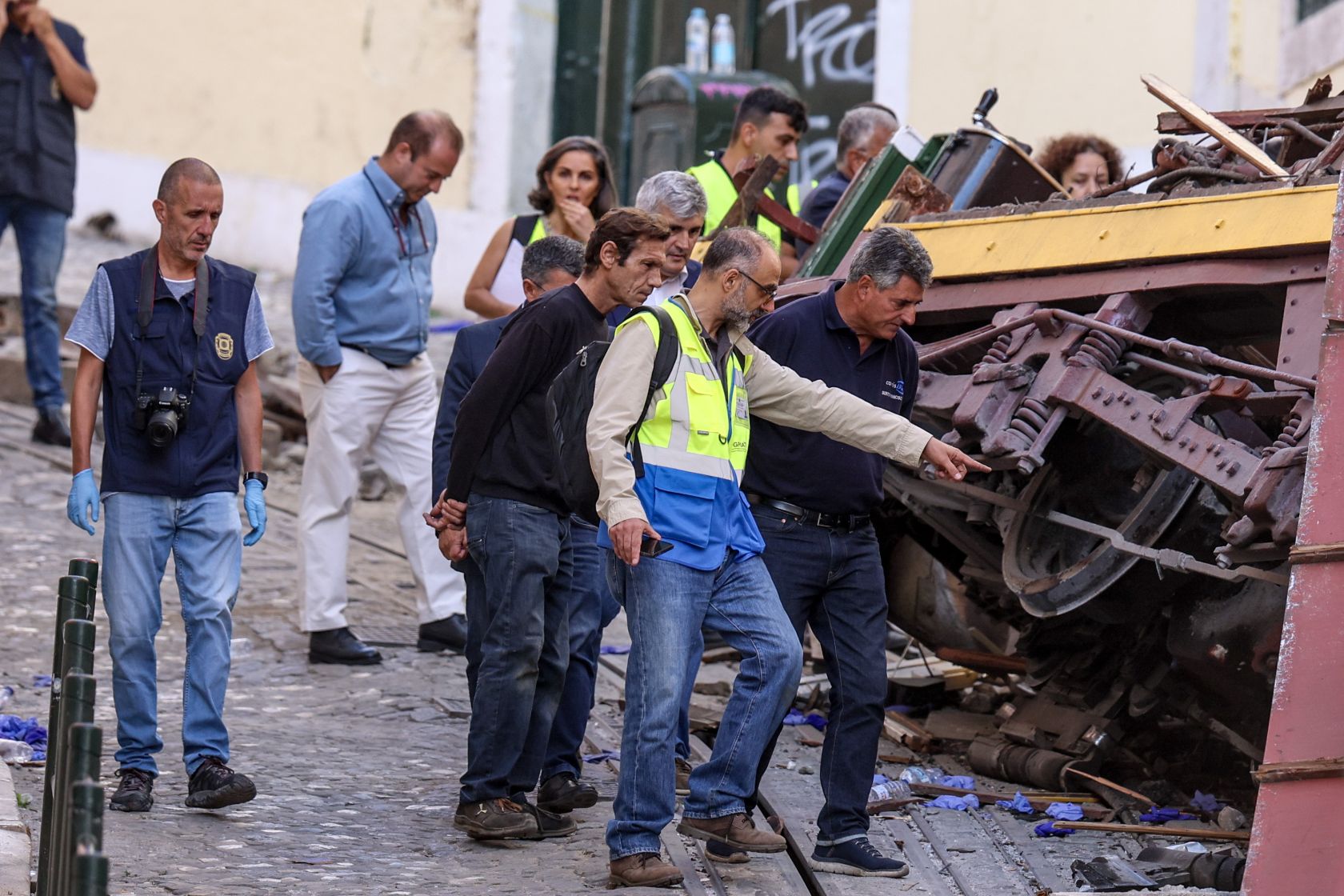
The Glória funicular accident, which occurred on September 3, resulted in 16 deaths and around two dozen injuries, including Portuguese and foreign nationals of various nationalities.
In the preliminary accident report, the Aircraft and Railway Accident Prevention and Investigation Office (GPIAAF) states that the inspections scheduled for the day of the accident "are recorded as having been carried out, although there is evidence that they were not carried out within the time period indicated on the corresponding log sheet."
"During the elevator's operation, a worker from the service provider observed the vehicles and spoke with the brakemen on several occasions," the investigation states, noting the existence of a daily, weekly, monthly, and semiannual maintenance plan.
According to the investigators, "although the contractually stipulated and planned maintenance actions were being recorded as completed in a dedicated recording system, to which Carris has direct access, evidence was collected that this record does not correspond to the tasks actually performed."
"There is evidence of critical tasks being performed in a non-standardised manner with disparate execution and validation parameters," the preliminary report states.
No cable observation
The GPIAAF reports that, on the day of the accident and the day before, the cable was not observed in the pit, nor was this covered by the maintenance procedures, "although the notice is contradictory regarding this specific aspect."
"The cable lubrication, scheduled for weekly use, is recorded as having been performed on August 28th. The monthly cable inspection is recorded as having been performed on September 1st," investigators found.
According to GPIAAF, "the location of the cable where it broke was not visible during any of these inspections," noting that, at this stage, it is not possible to conclude "whether or not any indication of a cable anomaly could have been observed some time before the break in the visible part near the trampoline [cable attachment point]."
Carris has contracted maintenance of the Glória elevator to a service provider for over 20 years.
Maintenance has been performed by the same company since 2019, with a team of five workers at the time of the accident.
"The training process for the five technicians, with experience ranging from 11 years to 8 months at the company, is based on the transfer of practical knowledge in a work environment, without the use of theoretical training or specific technical courses on the various equipment serviced under current contracts," says the GPIAAF.
The knowledge "was passed on over the years from Carris technicians to the service provider's executors, and from them in turn."
No updates
The execution procedures (standards), designed by Carris, "have not been updated for many years, nor does the service provider have the necessary engineering staff with specialised technical knowledge of funiculars and the means to develop, update, and adapt maintenance actions to the operational reality."
"The maintenance service provider's technical staff does not provide any guidance to the workers or supervision regarding the specific method of performing the work, which is carried out by Carris inspection," emphasises the GPIAAF.
The provider's quality system also does not ensure the “identification of weaknesses or the identification of opportunities for improvement with a focus on its maintenance activities, mainly focused on health and safety issues at work.”






 English
 Nederlands
 Deutsch
 Français
 Español
 Italiano
 Svenska
 Pусский
 中文
中文 Türkçe
 Português
 Polski
 عربي
عربي Suomi
Suomi עִברִית
 Português (Brasil)
Weird. Other (serious) sources tell that wrong cable was used that was not approved.
By Floyd from Algarve on 21 Oct 2025, 16:16
People are dead because of this. Shame on all concerned.
By Bill Browne from Algarve on 22 Oct 2025, 10:38
Disgraceful neglect. Massive compensation should be paid out. Maybe even manslaughter charges.
By Steve from Algarve on 23 Oct 2025, 20:27