

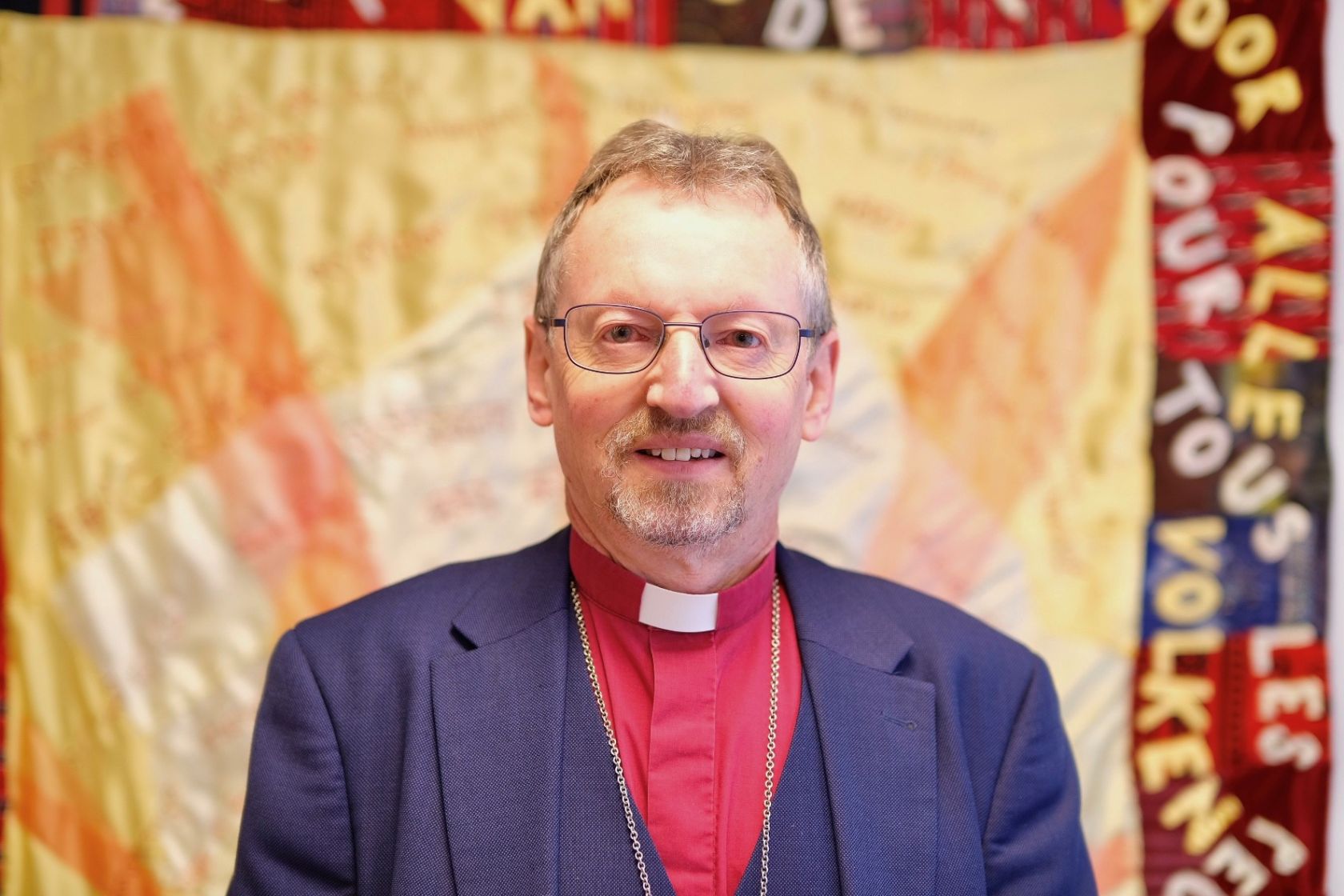
I have just returned from a long weekend in the Algarve, where I was visiting congregations of the Church of England’s Diocese in Europe in Palhagueira, Boliqueime and Praia da Luz, along with our Anglican clergy: The Reverend Rob Kean and The Reverend Carla Vicencio Prior. I look after Anglican congregations across Europe, as far north as Helsinki and as far East as Moscow, so it was a particular treat to visit one of the warmest and sunniest parts of our European diocese in the far southwest of the European continent.
There were some particular highlights. I enjoyed a visit to the palace of Bishop Manuel, the Bishop of Faro. We were shown his wonderful garden. I don’t think I had ever seen so many different vegetables and fruit trees growing together in a domestic garden. It felt like a new Garden of Eden.
We had a Christmas lunch with the remarkable Vale Silves community centre. I was honoured to be invited to present Christmas gifts to some of the elderly clients. And we watched some very moving and inspiring dance and singing from small children, teenagers and people in later life. I was deeply impressed with the centre’s mission to care for vulnerable people as a way of living out the command to love God and to love one’s neighbour as oneself.
Wondering around Loulé, I enjoyed seeing the Christmas decorations, the long red carpet, the elves, the reindeer and the enormous snowman! Significant snowfall in the coastal areas of the Algarve is extremely rare, so I was amused at the prominence of snow scenes that seem more typical of Germany or Scandinavia. The contemporary festival of Christmas is indeed a whole mixture of traditions from medieval Europe, Victorian England and twentieth-century United States.
Remembrance
Yet we recall that, at the heart of this annual celebration, is the remembrance of a baby born in poverty in a small town in the ancient Near East. This baby’s country was under military occupation. Threats to the baby’s life meant the family had to flee from their home and live as refugees. As the child Jesus grew, it became evident he had an exceptional religious intelligence. When he became an adult, he grew famous for his teaching and capacity to heal people. So exceptional was he, that people came to see him as Saviour, as Lord, as God with us. He became the founder of the world’s largest religion and the head of a community, the church, in which many millions of people have found love and hope and meaning.
Across my European diocese, we are seeing significant numbers of people coming to church and returning to church – especially younger people. That could be because the world seems to get increasingly scary, the challenges get more difficult and the answer to our questions harder to find. As the plight of humanity seems to feel more desperate, so we increasingly find ourselves in need of a Saviour. Perhaps, dear reader, you might even be one of those who finds themselves coming back to church this Christmas? If so, I hope you find a warm welcome and the possibility of discovering a spiritual home.
On my visit to the Algarve, I was thrilled to see evidence of people seeking to live in ways that follow the pattern of Jesus. Whether this is in the relationships of family life, in the care given and received in church community, in outreach to vulnerable children and isolated older people, or in concern and care for the natural world. It was my privilege to share in this, in the beautifully sunny and warm climate of the Algarve, for a few brief days.
I wish you all feliz natal, a very happy Christmas and a peaceful 2026.
Bishop Robert Innes
For the last 11 years, The Rt. Revd. Robert Innes has been the Bishop of the Church of England’s Diocese in Europe. He looks after some 250 congregations across Europe, Turkey, Morocco and Western Russia.






 English
 Nederlands
 Deutsch
 Français
 Español
 Italiano
 Svenska
 Pусский
 中文
中文 Türkçe
 Português
 Polski
 عربي
عربي Suomi
Suomi עִברִית
 Português (Brasil)
Spare me this, please.
By Colin Moss from Algarve on 19 Dec 2025, 11:37