


Question: Now and again I get totally fed up with trying to make any spiritual progress. As I don't seem to be getting anywhere in any case, I lose all my energy for practice for quite a while. Then I see how miserable I am becoming and have to start doing something again to get me out of the dumps. But when I read in one yoga text that you must ‘strive for perfection with diligent practice’ and then elsewhere some top-notch guru says ‘the only way is natural and spontaneous’, without any effort’, I get flummoxed and exasperated. My mind is continually swayed between doing and not doing. How to resolve the paradox?
Answer: At times of great frustration in our endeavours towards the Light, I think we all ask ourselves, “What am I doing this for? What’s the use? Why should I bother to make any effort on the path of Self-realisation?” We find all the handed down teachings enjoin us to practice austerities and spiritual exercises (known as sadhana in Sanskrit yoga terminology) of one kind or another and yet we are also told by Enlightened Ones that the true and perfect way to understand reality is effortless.
How do we reconcile these seemingly disparate instructions?
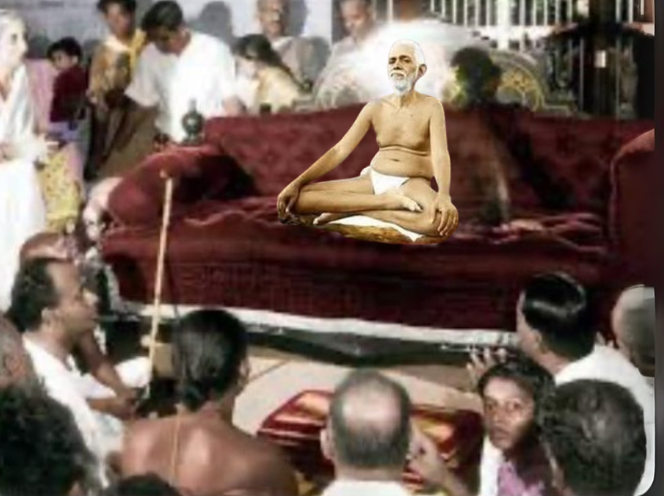
In the words of one of the greatest sages of our time, Bhagavan Sri Ramana Maharshi:
“Effortless and choiceless awareness is our real nature. If we can attain that state and abide in it, that is all right. But one cannot reach it without effort. If you do not realise your essential nature, your sight remains obstructed. What is the obstruction? Find it out and remove it. One’s efforts are meant only for the removal of obstructions which hide the true vision. The real nature remains the same. [When] once it is realised it is permanent... A practiser gains peace and is happy. That peace is the result of his efforts. But the real state is effortless. The effortless (superconscious state) is the true one and the perfect state. It is permanent.
When the efforts are spasmodic... so also are their results. 2
No doubt effortlessness is something we all crave for in our sadhana; perhaps from the intuitive knowledge that in reality we do not have to do anything: we only have to consciously be. But we have forgotten how. So we try out various methods to remind ourselves. It takes intensive effort merely to stay at home and conscientiously sticking to your meditation or yoga practice at specific times, day after day, when your friends are all out enjoying themselves, or inviting you to join them—especially if you feel you are getting nowhere with it all.
In my early days of practice, after a year or two of such self-imposed austerities, I can recall my own sense of glee when I came into contact with the school of thought whose motto was:
Don’t push the river - it flows by itself!
What an excitement surged in me at the words! It was almost a revelation in itself. It is so obvious! Am I not forcing the issue with all these austerities and practices? Why shouldn’t I just flow with it—like everything else in nature? The river has no need to push itself, it simply flows with its own momentum, seeking its level. If inner harmony and bliss is my true nature, then why am I making all this effort to become what I already am?
Maybe I am ignoring the flow of nature, I reasoned, if someone wants me to see a film with them and I refuse to go? Is that not in effect the natural process of the Guruverse at work in bringing me the invitation? So it was with such justifications that I decided with great relief to give in and abandon my sadhana.
However, I found that ‘just flowing’ was sooner idealised than done. If only one could just let go and relax enough to simply flow with the world, then that would indeed be the perfect way to realise the ‘essential nature’ of oneself. But for most of us, unhappily it does not seem to work that way. Have you ever tried to just flow?
In the first flush of freedom it may be wonderful—but how long can you hold it? One very quickly floats out of the conceptualised dream of ‘flowingness’ and gets sucked into the endless stream of conflicting thoughts instead. Such things as apprehension, worry, fear, love, lust, uptightness, and so on, soon begin clamouring like flotsam on the surface of the mind. We find ourselves getting whirled around in eddies of the social current and caught up in all kinds of unnecessary diversions destructive to one’s peace of mind, without even realising where the change began. Very soon the mind is back to its habitually disorganised and chaotic condition.
It was at such a point I realised that I could carry on with this kind of ‘free-flowing’ until Doomsday and still not be any the better for it. This, I thought, was the state of mind of the average cabbage. But having become disillusioned with both my sadhana and with free-flowing I was totally without direction and succumbed to that dire affliction of spiritual aspirants—the ‘dark night of the soul’. This is a condition in which life becomes utterly meaningless and loses all its savour. Whenever soul sickness came upon me I always turned to nature for solace.
Part 2 to follow: How I found my way
From: Sharing the Quest: Revelations of a Maverick Mystic
Find on www.amazon.co.uk / or for easy postage: www.amazon.es








 English
 Nederlands
 Deutsch
 Français
 Español
 Italiano
 Svenska
 Pусский
 中文
中文 Türkçe
 Português
 Polski
 عربي
عربي Suomi
Suomi עִברִית
 Português (Brasil)
Follow us on social media