


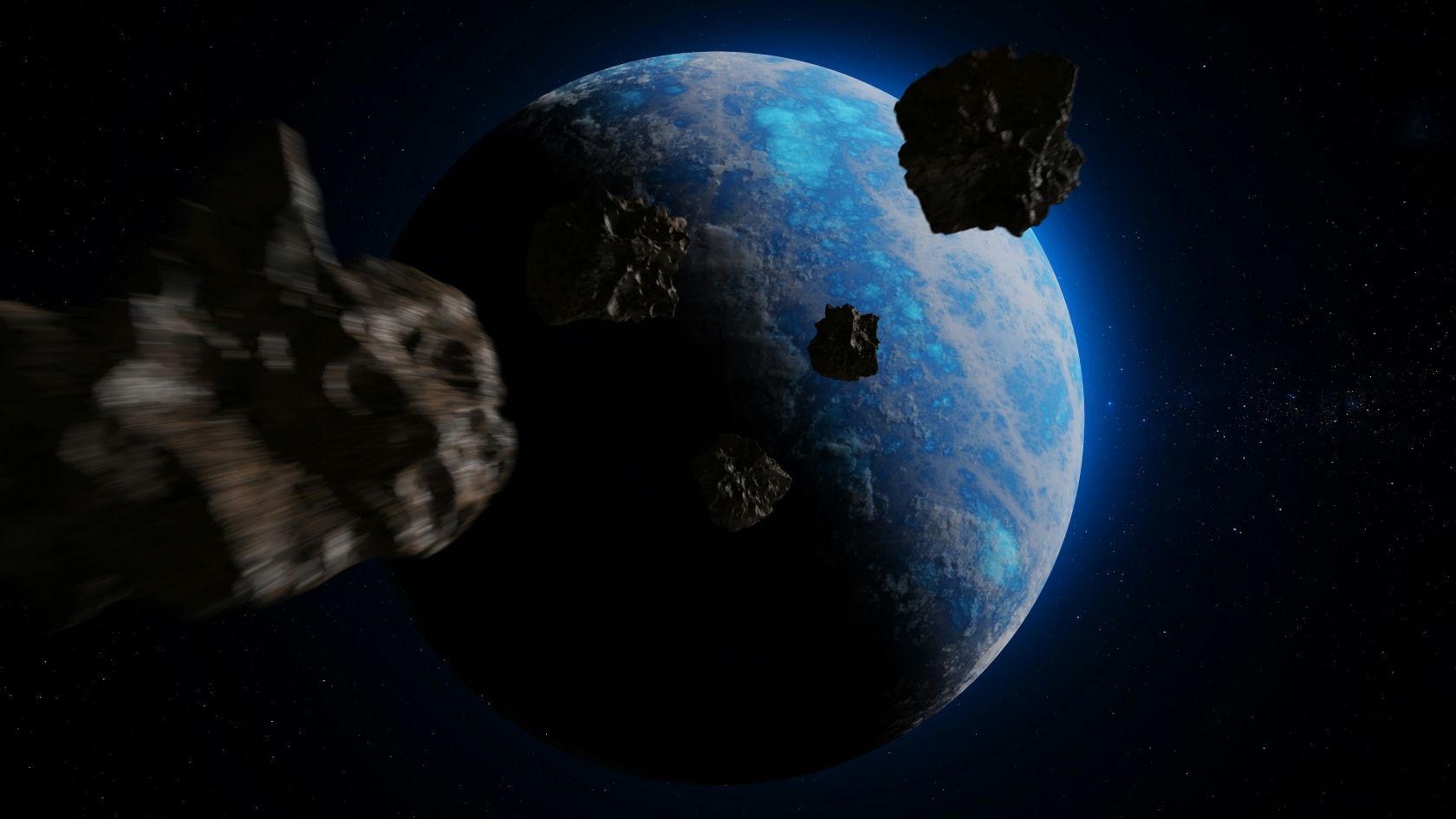
Scary, right? Especially because I’m not talking about a “might clip the atmosphere and give us a nice light show” sort of asteroid, but a proper one. The sort that would have its own Wikipedia page and a projected impact zone the size of France. Let’s just assume it’s twelve months before the game would be over for all of civilisation. How grim is that?
Now, Hollywood would have us all believe that humankind would respond by pulling together. Governments would cooperate, Bruce Willis would shave his head, punch someone at NASA and save us all with just five minutes to spare. This, of course, was always absolute nonsense.
What would happen is probably more like this. For the first 48 hours, nobody would believe it. The scientists would hold a press conference, with graphs, animations, and a bloke with a laser pointer saying, “This is a statistically significant extinction-level event.” Immediately, someone on social media would reply: “Funny how this ‘asteroid’ appears just as they want to raise fuel duty again.” Within hours, there would be YouTube videos titled “ASTEROID HOAX EXPOSED” featuring a man with huge headphones explaining that rocks cannot travel through space because “space is a simulation” and the asteroid impact is a lie planned by “the deep state” and it’s all Donald Trump and Nigel Farage’s fault.
Governments would panic, there would be emergency summits, not to stop the asteroid, but to argue about who gets blamed when it eventually hits. The Americans would accuse the Chinese of “not sharing asteroid data.” The Chinese would accuse the Americans of “weaponising space rocks.” Europe would form a committee to decide which font to use for public information leaflets. The British government would immediately announce a “robust and world-leading Asteroid Preparedness Strategy,” which would involve an (0800) helpline that doesn’t work and a website that crashes under the strain of people trying to find out whether Kent will still exist. And then, inevitably, someone would politicise it. One party would say the asteroid is the direct result of years of underfunding science. Another would insist that if we hadn’t left the EU, a joint UK/EU effort might have saved the day and the planet.
Public reaction would split neatly into four camps. The first group would panic. Supermarkets would be stripped bare within hours, not of essentials like medicine or batteries, but of toilet paper, prosecco and dried pasta. There would be fistfights over tinned tomatoes, someone would hoard quinoa, even though nobody actually likes the stuff.
The second group would deny everything. These people would continue booking holidays, insisting that “they’ve been predicting the end of the world for years.” They would still plan to go to Benidorm, as though the asteroid had politely agreed to wait until they had had their holiday.
The third group would monetise the whole thing. Influencers would film themselves crying into ring lights. Survival gurus would sell £499 “Asteroid Ready” courses teaching us how to build a bunker out of pallets and then hope. There would be branded hoodies with #AsteroidLife printed in grey font. Netflix would commission a six-part documentary narrated by someone whispering dramatically about “a rock that changed everything.” Amazon would sell out of telescopes so people could stare at the thing that’s about to kill them.
And the fourth group? They’re the most annoying. They’d complain that the asteroid warnings are too alarmist or not alarmist enough, and that the impact map is confusing.
Now, you might think that with a year to go, humanity would rally to try and stop it. After all, we have rockets, we have nukes, and we even have Elon Musk, who’s been itching to fire something dramatic into space for years. But here’s the problem. Agreeing on how to stop the asteroid would take at least 11 of the remaining 12 months.
One plan would be to gently nudge it with a spacecraft. Another would involve blowing it up completely. Another would suggest painting it white to reflect sunlight. Someone would suggest “thoughts and prayers,” and Greta Thunberg would point out, quite rightly, that the asteroid is not the real problem.
Then come the lawyers. If we deflect the asteroid and it hits somewhere else, who’s responsible? If it breaks into several pieces and one of them flattens Belgium, will the Belgians get compensation? Can you actually sue an asteroid? These questions would be debated at length while the asteroid hurtles closer and closer at 30,000 miles an hour.
Eventually, a mission would be approved. It would be over budget, behind schedule, and staffed partly by people who once organised the Commonwealth Games. The launch would be delayed because a clipboard can’t be found, and a stiff northerly breeze compromises safety. When it finally takes off, someone would discover that a crucial component was outsourced to the lowest bidder and doesn’t survive at temperatures above room temperature. Oops!
All the while, normal life would continue in the most bizarre way imaginable. People would still go to work, still complain about traffic, still argue about whether electric cars are worse than diesel when, frankly, in nine months, it won’t matter what you’re driving because there won’t be any roads left to drive on. There would be final concerts, final football matches and endless “last chance” tourism opportunities, so the travel companies can make fat profits that they’re never going to be able to spend. We could see Paris before it’s vapourised, for £6,999. Ryanair would charge extra for seats with a window view of the impact, and the asteroid would, naturally, be clearly visible from the Alentejo.
As the final weeks grimly approached, there would be a strange calm. News presenters would smile just that little bit too much, the weather forecast would seem mildly ridiculous with sunny spells in the north and total annihilation in the south by Saturday evening. Great.
On the final day, politicians would make speeches about human resilience. Billionaires would retreat to bunkers they’ve been quietly building for years. Everyone else would gather with friends, family, or total strangers in pubs, on beaches or in gardens whilst staring blankly at the sky. And when the asteroid finally arrives blazing across the atmosphere, there would be one last, very human, reaction. Someone, somewhere, would look up and say. “Oh. My God, that’s a lot bigger than they said it was.”
And in that brief, spectacular and terminal moment, it would become abundantly clear that the end of the world didn’t come with heroics, unity or grand solutions. It came with arguments, incompetence, silly memes and glitchy government websites. More of a case of “Ahh-my-giddy-aunt!” than Armageddon.








 Portugal Handbook
 English
 Nederlands
 Deutsch
 Français
 Español
 Italiano
 Svenska
 Pусский
 中文
中文 Türkçe
 Português
 Czech
Czech Hungarian
 Polski
 عربي
عربي Suomi
Suomi עִברִית
 Português (Brasil)
I really enjoyed your Article and posted it this morning. The Daily Asteroid Reports with your Host Rebecca Campbell - Citizens Astrophysicist
By Rebecca Campbell from USA on 03 Feb 2026, 15:16