


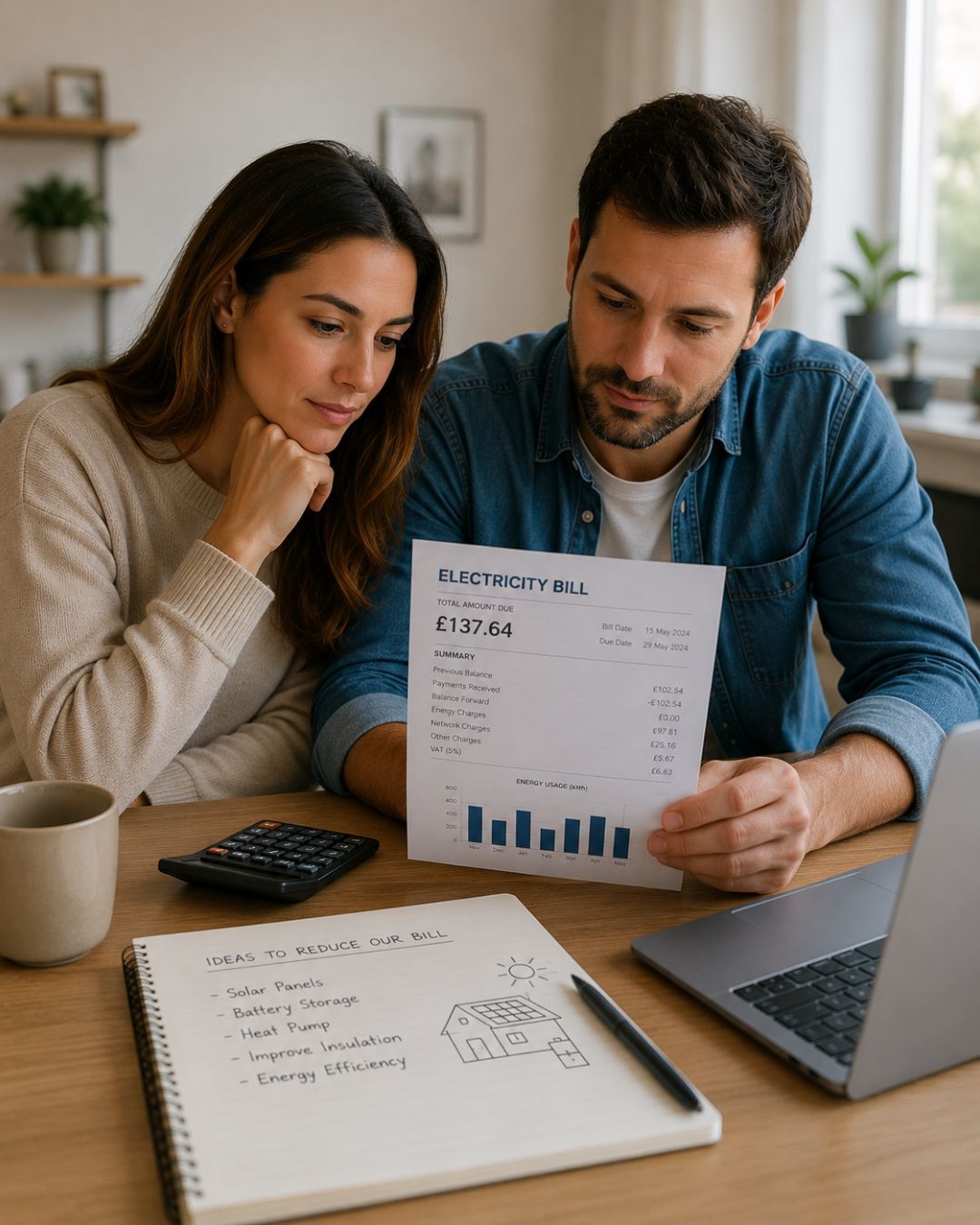
My answer is almost always the same: “Before we talk about solar panels, let’s take a closer look at your electricity bill.”
That is where every successful solar project begins.
When we receive our electricity bill, we usually focus on the final amount and assume solar panels will reduce the entire cost. The simple answer is: not entirely.
Your electricity bill includes both fixed and variable charges. Solar panels mainly reduce the variable cost of the electricity you buy from the grid, while some fixed charges will always remain.
One of the main fixed charges is your contracted power, shown in kVA and linked to your CPE (Delivery Point Code), which identifies your property on Portugal’s electricity network. The higher your contracted power, the higher your daily network access charge, regardless of how much electricity you actually use.
If you are building a new home or planning to install an EV charger, heat pump or other high-demand equipment, choosing the correct contracted power from the beginning can save time, unnecessary costs and administrative procedures later.
Next come your electricity tariffs. Depending on your contracted power, you may have a single-rate, dual-rate or three-period tariff. Supplies above 20.7 kVA are generally billed using three consumption periods: Vazio (off-peak), Cheias (standard) and Ponta (peak) - the same terms you will find on your electricity bill.
This is where your bill starts telling a story.
Electricity consumed during Cheias and Ponta generally corresponds to the hours when your solar panels can produce energy for your home. Your Vazio consumption, usually overnight, helps determine whether battery storage is worthwhile and, if so, what capacity may be appropriate.
Let’s do a simple exercise.
Add together your monthly consumption during Cheias and Ponta. Divide that figure by 30 to obtain your average daily consumption, then divide the result by approximately 10.
This gives you a rough indication of the solar PV system size that may suit your property.
Now repeat the exercise using your Vazio consumption. Divide that monthly figure by 30 and you will see how much electricity you typically use each night. This provides a useful indication of the battery capacity that may be worth considering.
Of course, it does not replace a professional energy assessment, but it provides a useful starting point. Roof orientation, shading, consumption habits, inverter size, battery capacity and future energy needs should all be considered before designing a system.
However, this simple exercise already helps answer some of the most common questions: Do I need more panels? A larger inverter? Battery storage? Or, if I already have a system, do I simply need to optimise it?
Very often, the answer is not installing more equipment, but designing a system that matches your actual consumption profile—today and in the future.
Above all, remember one simple rule: the best solar system is not the biggest or the most expensive. It is the one that produces the energy you actually need, when you need it most, providing the best balance between investment, savings and energy independence.
I will finish with one recommendation that often surprises my clients: always keep your home connected to the grid.
The electricity grid remains a backup available. Even with solar panels and batteries, there will always be days of lower production or unusually high consumption. You will still pay some fixed charges, but the greatest savings come from understanding your electricity bill and choosing the right system from the start.
At Soren – Renewable Energy Consulting, we believe every home is different. Our role is not simply to install solar panels, but to design the right energy solution for the way you live.






 English
 Nederlands
 Deutsch
 Français
 Español
 Italiano
 Svenska
 Pусский
 中文
中文 Türkçe
 Português
 Polski
 عربي
عربي Suomi
Suomi עִברִית
 Português (Brasil)
Follow us on social media