


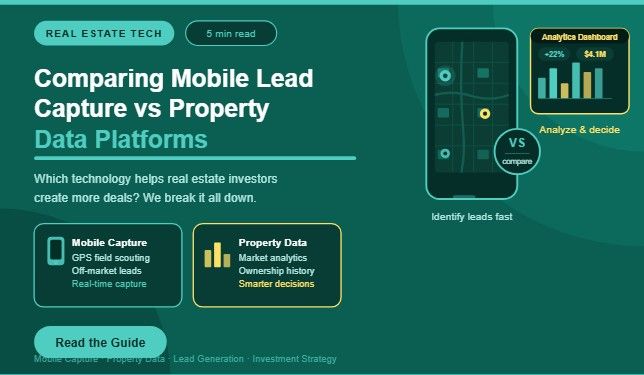
Which Technology Enables Investors to Create Investment Opportunities?
This is why the best and most productive real estate professionals have dependable sources of leads that result in deal flow at reliable frequency, thus streamlining decision-making because they are able to track way more key performance indicators. Increased competition, alongside the speed of change in terms of market demand and preferences has meant that technology is now an indispensable enabler through which to identify, acquire or assess property opportunities. To help them make their decision, investors will often turn to resources like DealMachine vs PropStream that have the details of how these various tools connect with prospecting workflows and improve data accessibility. Two popular examples are mobile lead capture apps and property data platforms. Though both support opportunity generation, they have two different roles in the investment process. By knowing how each solution is working, this allows investors to pick solutions that fit in with their workflows and enhance efficiency which ultimately leads to enhancing long term investment strategies.
Understanding Mobile Lead Capture Technology
Investors in the field can utilize mobile lead capture technology to obtain property details from their phones. These are built to assist real-time opportunity tracking by letting professionals log property information, snap photos, save GPS coordinates and make notes on the spot. Regardless of their approach, investors who consistently scout off-market opportunities are often well served by mobile solutions as they enable the immediate recording and documentation of promising leads. Storing pertinent information quickly prevents anything important from being, well, lost; as now professionals do not have to try and remember what they told others or manually note taking. Mobile lead capture tools are great for the investors that enjoy hands-on prospecting methods. Instant data collection increases workflow efficiency and allows opportunities to later be revisited in an organized manner.
Read Also Mobile Lead Capture Technology: Major Benefits
In the Field Immediate Lead Entering, Location-based property identification, Notes systematically stored for reference in the future, Faster documentation of off-market opportunities, Increased flexibility in prospecting workflows.
What Are Property Data Platforms?
Data platforms offer structured real estate datasets that give investors a detailed view of property deals to help analyze opportunities. These platforms have information about ownership records, transaction history, recent pricing patterns and property characteristics as well as indicators of market activity. Investors can simply refer to centralized dashboards that compile relevant data as opposed to not noticing the vital information by personally searching through thousands of sources. Structured Insights enable professionals to objectively compare properties and apply a consistent set of evaluation criteria across opportunities. Although property data platforms are used typically in the research phase of investment analysis as decision accuracy relies heavily on being armed with reliable and comprehensive information.
Main benefits of property data platforms: Access to large property datasets, Structured insights for investment evaluation, Consistent comparison between opportunities, Improved research efficiency, Enhanced decision-making accuracy.
Key Differences Between Mobile Lead Capture and Data Platforms
Mobile lead capture & property data platforms fall in different phases of the investment workflow. Mobile tools are designed for rapidly pinpointing and capturing opportunities, while data platforms aim at analyzing property information prior to making decisions. The speed of mobile applications enhances and their accessibility together allows investors to capitalize on an opportunity in real time. Data platforms provide depth and structure, enabling professionals to think more about the market environment and financial potential. Recognizing these distinctions gives investors a way to choose solutions that work side by side with their strategy and avoid the "one tool for every task" hazards. Where mobile tools are quick to capture opportunities, data platforms take a closer look at those opportunities by providing insights that will lead you through the decision-making process more widely.
When Mobile Lead Capture Tools Add More Value
This is especially true for mobile lead capture tools as- Investors actively search target markets and spot potential opportunities by sight. Mobile allows professionals who routinely evaluate neighborhoods or embark on property searches in specific geographic districts to do it all from wherever they are. The ability to instantly record leads reduces the chance of missing any crucial information, which in turn sets us up for proper documentation and following through with opportunities as these processes are streamlined. Mobile accessibility also helps speed up organization and allows greater distance between different prospects in the works. Such tools call for proactive prospecting strategies based on instant identification rather than delay research.
Property data platforms: A tale of when they become unavoidable
Investors benefit tremendously from property data platforms when they know in detail before acting on a lead. Structured dwelling data enables professionals to assess pricing trends, ownership history and probable performance metrics. Evaluating based on data increases analytic precision and facilitates more cohesive investment choices. Investors who depend on structured datasets can uniquely discover opportunities that fit their strategy but also reinforce boundaries against entering properties they feel are unlikely to perform as expected. By enabling verification rather than assumption of raw data at the organisational level, reliable data environments support being able to make decisions based on insights.
Why Use Both Technologies Together, for Most Investors
While many pros opt for one of the other mobile lead capture tools or property data platforms, others integrate both solutions as a means of improving workflow efficiency. Mobile tools identify opportunities in the moment while data platforms enable a full assessment of those same opportunities. The combination allows investors to best exploit both speed and accuracy, creating a balance of sorts. You can capture opportunities in real-time and then apply structured insights for analytics on the other side. This method streamlines workflow and helps minimize lags incident between discovery and evaluation. More organized pipelines and the ability for opportunities to move through the investment process can thrive with integrated technology environments.
How to Choose the Right Approach According To Investment Style
The kind of investor you are tends to determine whether property data platforms or mobile lead capture tools win out. Field-facing professionals may use mobile tools to a greater extent, whilst analyst investors will draw their information from intuitive structured data locations. Identifying workflow preferences helps investors choose technology that enables operational efficiency and enhances opportunity management. Choosing tools carefully and purposely creates no unnecessary complexity with systems because your systems must fit into the reality of what you are trying to achieve with investment. Adopting technology on an as-needed basis, based on actual workflow needs not wants and desires boosts productivity levels for you and the rest of your team while ensuring a more steady deal flow.
Conclusion
Both mobile lead capture tools and property data platforms are crucial to modern real estate investing. Mobile solutions for the supply side speed-up and make opportunity identification easier, while property data platforms help others evaluate them with more structured properties insights. Both these techs help streamline processes in lead management. Investors who understand how tools like these operate in the investment lifecycle can construct systems for finding and evaluating opportunities with greater economy. The right technology combination advocates better decision-making, improves the consistency of operations, and enhances investment performance over many years in competitive real estate markets.






 Portugal Handbook
 English
 Nederlands
 Deutsch
 Français
 Español
 Italiano
 Svenska
 Pусский
 中文
中文 Türkçe
 Português
 Czech
Czech Hungarian
 Polski
 عربي
عربي Suomi
Suomi עִברִית
 Português (Brasil)
Follow us on social media