


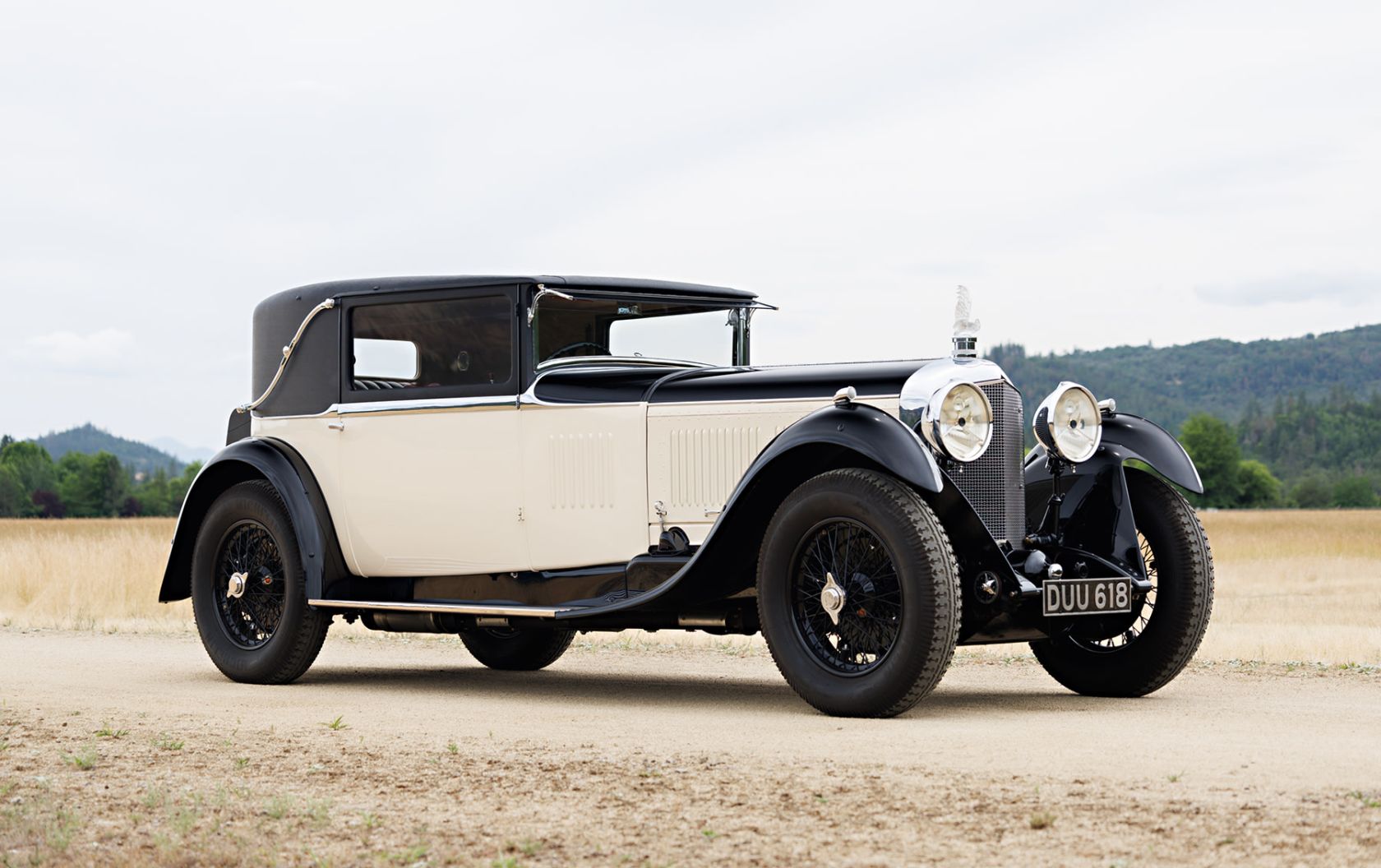
Somewhere between its enormously upright radiator and those impossibly long bonnet louvres lies the entire DNA of modern Bentley. Strip away the infotainment screens, the Nappa leather quilting and the marketing fluff, and you'll find that today’s Bentleys are still trying to be this car.
Endurance
The Speed Six wasn’t born to be pretty; it was born to win. In the late 1920s, when racing drivers wore leather ‘Biggles’ helmets, goggles and impressive moustaches, W.O. Bentley built machines with a single-minded obsession. Endurance. The Speed Six was essentially an evolution of the 6½ Litre but with the attitude adjusted from “confident” to “utterly unstoppable”. It had a bigger engine and more muscle. This was a car that went to Le Mans, glared straight at the competition, and won.
Not only did it win. It won twice, back-to-back, against faster, lighter, and far more sprightly competition. The Speed Six didn’t win because it was nimble; it won because it could keep going when everything else broke, overheated or simply gave up. Bentley understood something fundamental: speed is pointless without stamina and the essential ability to endure.
That idea of relentless, dignified performance still provides the cornerstone of today's Bentley Motor Cars. Look at a modern Continental GT. It weighs roughly the same as Zambujeiro do Mar, yet it crosses continents at three-figure speeds with the serene indifference of a private jet. That isn’t an accident. That’s “Speed Six thinking” translated for a world of emissions regulations and compliance.
The Speed Six had presence. It didn't offer swoopy lines or theatrical curves. The message was delivered through scale, proportion and mechanical brute force. It had a long bonnet because there’s a massive engine lurking beneath. The huge upright grille is functional because airflow is important to keep that huge engine cool. Exposed headlamps are there because great speed obviously demands a clear view of the road ahead; they're not there as a fashion accessory.
Functional luxury
Fast forward to today, and Bentley still embraces functionality. The grille remains proud and unapologetically vertical. The bonnet still stretches forward and arrives long before you do because there's a huge lump hiding under all that expansive lustre. Even the modern Bentayga, an SUV, carries itself like landed gentry. This is where Bentley differs from its rivals. Rolls-Royce does theatre, Ferrari does hysteria, whilst Lamborghini does nightclub lighting. Bentley, on the other hand, has authority. And that authority has been inherited straight from the Speed Six.
Inside the Speed Six, luxury was never the point, but quality was. Everything felt engineered. Switches were substantial because they had to be. Leather was thick because thin leather wears out. Wood was there because metal is cold and sharp. This wasn’t luxury as indulgence, it was luxury as preparedness.
Modern Bentleys follow the same philosophy, even if they’re now stitched by artisans rather than coachbuilders with oil under their fingernails. Yes, the cabins are sumptuous, but they’re also reassuringly solid. Doors close with a weight that suggests the world outside is now somebody else’s problem. That sensation, the sense of being enclosed in something formidable, remains pure Speed Six.
What about the engines? The Speed Six’s straight-six wasn’t about revs, it was about torque, delivered calmly and continuously. That ethos lives on in Bentley’s modern powertrains, whether it’s the thunderous W12 (now sadly consigned to history) or the latest V8S and hybrids. Bentley engines don’t scream, they assert. Press the accelerator in a Continental or Flying Spur, and there’s no hysteria, no operatic crescendo, just a deep, determined surge. That’s exactly how a Speed Six would have felt devouring a pre-war straight at Le Mans. Effortless, inevitable and faintly amused by the struggle of its competitors.
Substance over spectacle
Let’s not forget the venerable Bentley Boys. Those fearlessly well-heeled adventurers who raced hard, drank harder and lived as if tomorrow was optional. They weren’t aristocrats, they were enthusiasts with money and plenty of raw nerve - recklessness even. Bentley still courts that type of customer today. Not the nouveau riche show-off, but quietly confident individuals who value substance over spectacle.
Modern Bentley marketing talks about performance and luxury, but underneath, it’s still selling the same idea the Speed Six embodied. The idea that you can go anywhere, at speed, in comfort and without fuss. This is why Bentley survived where so many others haven't. At Bentley, they never chased trends, they refined a philosophy.
The Speed Six wasn’t glamorous in the modern sense, but it was absolutely authentic. And authenticity is Bentley’s greatest asset today. In an era where cars are increasingly digital, disposable and forgettable, Bentley remains stubbornly tactile, mechanical and proud of its past. So, when you stand beside a Speed Six, it's oil-scented, purposeful and absolutely magnificent. You're not just looking at a vintage racing car, you’re looking at the blueprint for everything Bentley still believes in. The confidence, the endurance and that steadfast refusal to be too showy.
Deep down, the Speed Six philosophy is the reason a modern Bentley feels the way it does. Not too flashy, not too frantic, just absolutely certain of itself. And quite frankly, in a world that in too many ways has lost the plot, that kind of certainty feels priceless.








 English
 Nederlands
 Deutsch
 Français
 Español
 Italiano
 Svenska
 Pусский
 中文
中文 Türkçe
 Português
 Polski
 عربي
عربي Suomi
Suomi עִברִית
 Português (Brasil)
Follow us on social media