

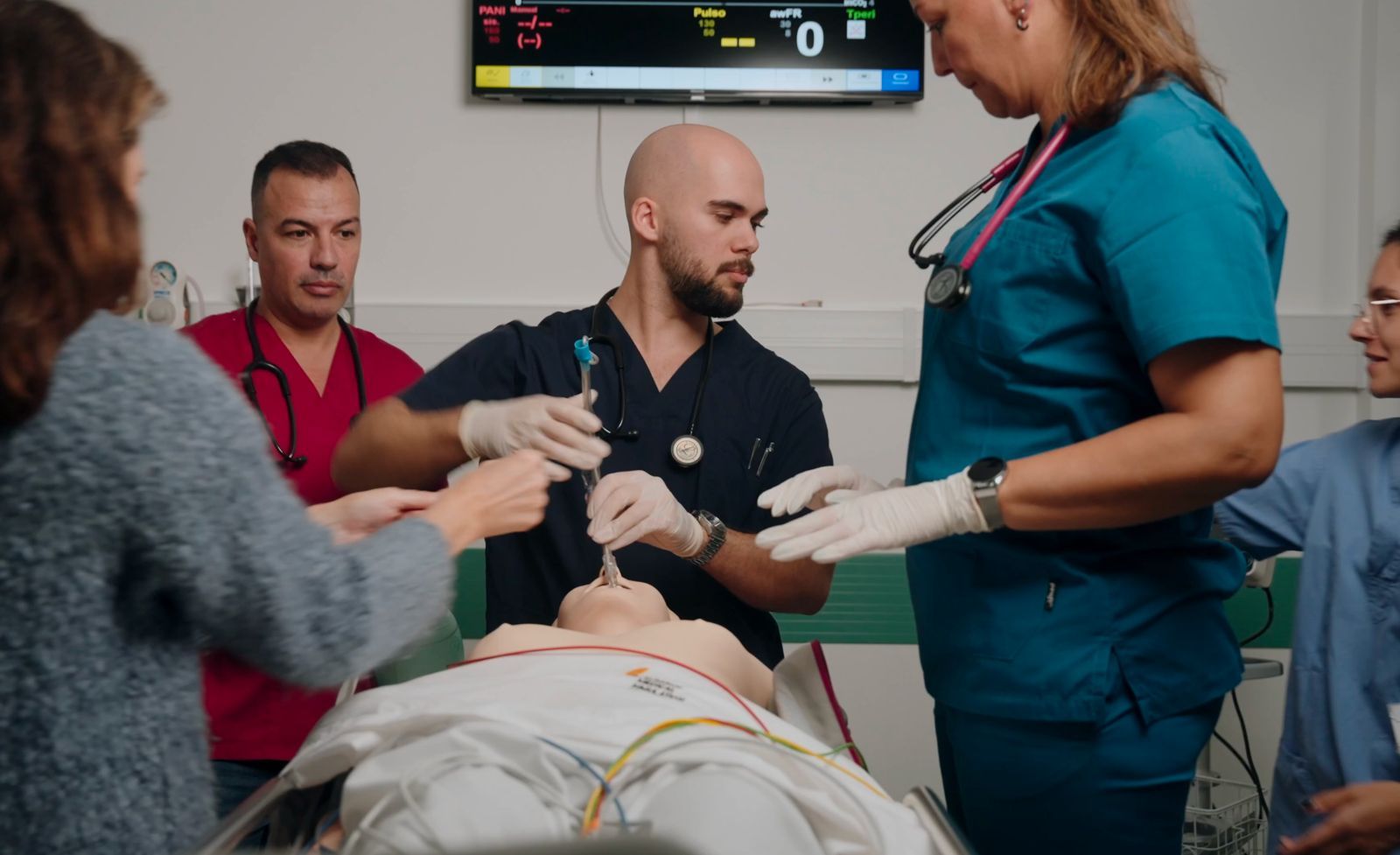
Caring for distressed newborns while they’re in their mothers’ arms, making rapid diagnoses with ultrasound imaging, leading interprofessional teams and resuscitating critically ill patients – these are just some of the skills that over 600 doctors and nurses are learning at the Algarve Medical Simulation Centre at the University of Algarve between April and June of this year.
Clinical simulation is a hands-on learning technique in which healthcare professionals practice in a simulated environment before transferring their new skills to patients. Like pilots training on flight simulators, these doctors and nurses are training to respond to complex emergencies or unexpected complications that they may never have seen in real life. The Algarve Medical Simulation Centre at the University of Algarve mirrors a real hospital, complete with an emergency room, an operating theatre, an intensive care unit and an obstetrical suite. Instead of practicing on real patients, the teams first train their skills on life-sized mannequins complete with heartbeats, breath sounds and vital signs. There is also a neonatal mannequin that weighs barely 2kg, a mannequin that can simulate a cardiac ultrasound exam and even one that can simulate a difficult obstetrical delivery.
The medical school at the University of Algarve has a long history of simulation-based training, having incorporated simulation into its curriculum since its founding in 2009. In 2018, a team of Algarve medical students won both the Portuguese and European medical simulation competitions, establishing the University as a leading centre for medical simulation. In 2021, the University of Algarve was a national pioneer in interprofessional simulation, bringing together medical and nursing students to learn teamwork skills, including leadership and communication, during their final year of study. These skills are essential to the efficient functioning of healthcare teams but are not traditionally taught in medical and nursing schools. By improving their teamwork skills through simulation, healthcare professionals can ensure a safer environment for their patients.
Dr Jorge Fonseca, co-director of the simulation centre, an anaesthesiologist and intensive care physician who works in both Portugal and the United Kingdom, emphasised that, while the centre is equipped with advanced technology, its core purpose goes far beyond technical skills training.
“The real value of simulation lies in creating a safe space where healthcare professionals can make mistakes and learn from them without any risk to patients. But just as importantly, our programmes are grounded in systems thinking and human factors. We are not simply training individuals to perform procedures—we are helping teams understand how they work together, how decisions are made under pressure, and how errors arise within complex systems.
In everyday clinical practice, there is often little time to pause, reflect, or question. Simulation provides that opportunity. It allows professionals to explore not only what went wrong, but why—and how similar situations can be managed more safely in the future.”
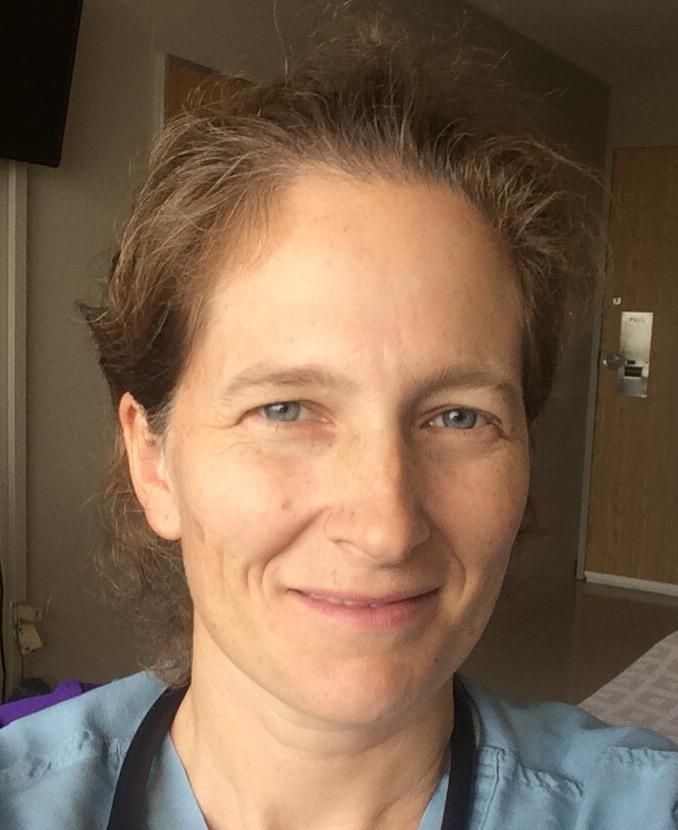
This focus on human factors has been strengthened through international collaboration, including the contribution of Dra. Loredana Bessone, a European Space Agency instructor, whose work in high-performance team training has helped shape the Centre’s approach. By combining technical training with these broader perspectives, the Centre aims to foster better communication, stronger teamwork, and ultimately safer care for patients.
The Algarve Medical Simulation Centre at the University of Algarve opened in 2023, with support from European funding. It occupies the 4th floor of the medical school and has a mandate to train both undergraduate healthcare students and postgraduate medical professionals. Since its opening, over 500 medical and nursing students and 1000 healthcare professionals have taken courses at the Centre. This spring, with the support of European funding, the Algarve Medical Simulation Centre is adding twenty-five new courses to its schedule. These include courses in abdominal ultrasound, emergency response training for nurses, difficult airway management, leadership for healthcare teams, laparoscopic techniques for surgeons, artificial intelligence, catastrophe management and nutrition, amongst others. Healthcare salaries in Portugal are low, making it challenging for many nurses and trainee doctors to access advanced training. With the help of the grant, the courses are being offered at very low cost to participants, allowing many healthcare professionals to do simulation training for the first time.
Marco Piedade, an emergency nurse, is the Director of the CriticalSIM course, which is training nurses to provide emergency care to critically ill patients. He says the grant has been a unique opportunity to bring many nurses to the simulation centre: “Cost is always a limitation in simulation training because it is intensive and expensive to provide. Having this grant has allowed us to train many nurses who have never done this type of training before. We have noticed an immediate impact in our teams in terms of having everyone using the same language and following the same protocols. The nurses are paying more attention to how they communicate with each other and with the patients. All of this will improve the care that we provide.”
Teresa Figueiredo is a consultant radiologist and Director of the Abdominal Ultrasound course. “In Portugal, ultrasound has traditionally been used only by radiologists, but the doctors who are coming to this course are really diverse. Some are trainee radiologists, some are intensive care or emergency room physicians, and some are surgeons, who want to use ultrasound to identify surgical emergencies quickly. Ultrasound is an amazing technique in the hands of doctors who know how to use it and can greatly improve the quality and speed of diagnosis.”
The Algarve Medical Simulation Centre plans to continue offering these new courses in the future, with the goal of improving healthcare delivery in the Algarve. They will be looking for additional sources of funding to help offset costs for participants. If you are interested in finding out more, please email the Algarve Medical Simulation Centre at centrosimulacao@ualg.pt.






 English
 Nederlands
 Deutsch
 Français
 Español
 Italiano
 Svenska
 Pусский
 中文
中文 Türkçe
 Português
 Polski
 عربي
عربي Suomi
Suomi עִברִית
 Português (Brasil)