


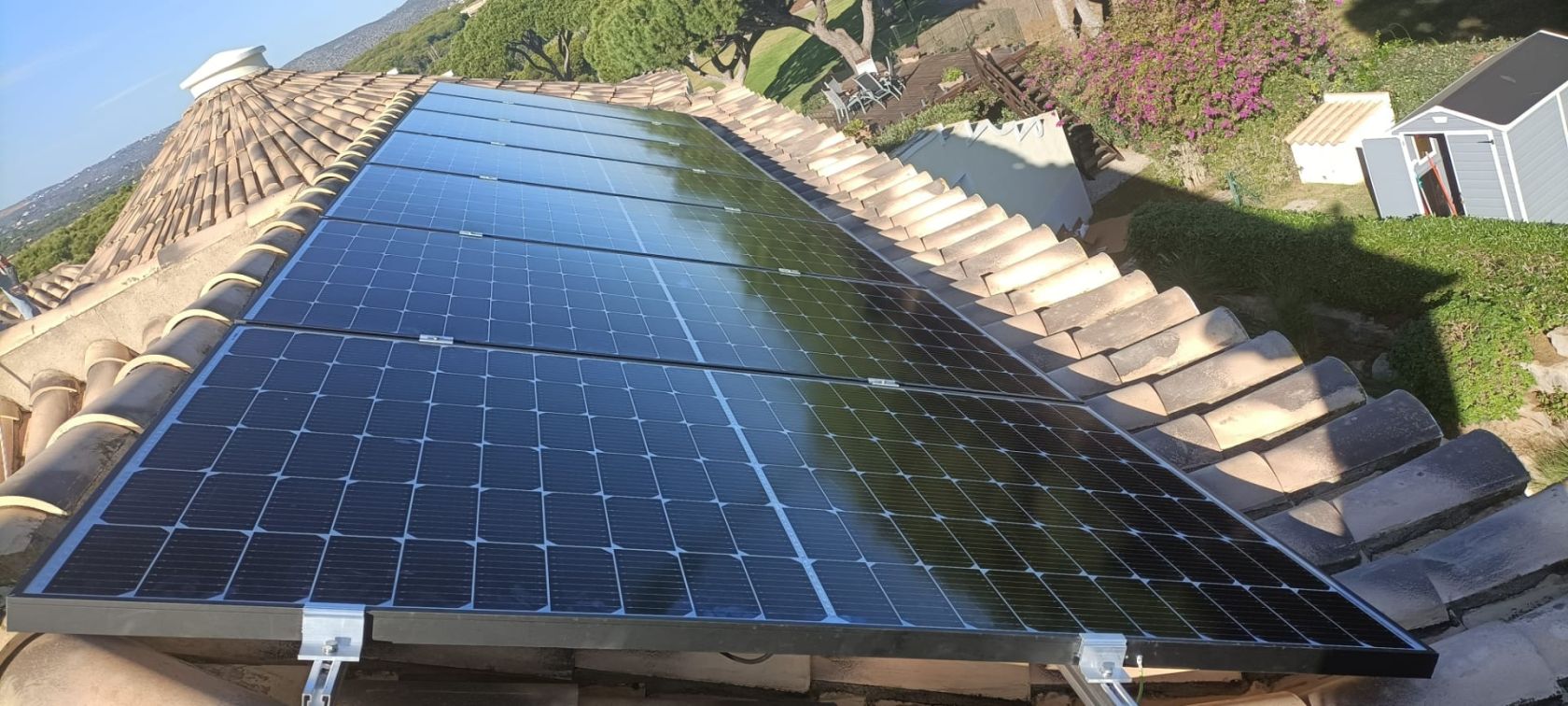
For many homeowners, aesthetics play an important role. Panels do not always integrate seamlessly into the property’s design, and, in some cases, the available space may seem insufficient or poorly oriented to achieve the desired production. These concerns often lead to hesitation or even the decision not to proceed.
However, what may initially appear as a limitation can become a strategic advantage when properly analysed. Every property is unique. Roof pitch, available space, shading and architectural constraints all directly influence the final design, and this is where the real work begins: designing, not just installing. A south-facing orientation is widely considered the most efficient in terms of annual production.
While technically correct, it does not tell the whole story. In practice, east and west orientations can be highly effective and often better aligned with real consumption patterns. East-facing panels generate more energy in the morning, while west-facing panels extend production into the late afternoon. Instead of concentrating production at midday when consumption may be lower and batteries, if installed, are already charged, energy generation can be distributed throughout the day, better matching actual demand.
Solar production is not only about how much energy is generated, but also when it is generated. In winter, with lower sun angles and shorter days, production naturally decreases. In summer, production starts very early “with the chickens”, as we say in Portugal and continues throughout the day. By optimising panel orientation, it is possible to improve early-morning production when batteries may be depleted, extend generation into the evening peak and reduce reliance on storage by better aligning production with consumption. This is where proper system design becomes essential.
While many homeowners consider investing in batteries to ensure energy availability at night, they are not always the most efficient first step. A well-planned orientation strategy can reduce the need for large storage systems, lower initial investment and improve overall system efficiency. In this sense, panel orientation becomes a natural extension of the property’s energy strategy. At this stage, we enter a more technical aspect of system design, which we call “strings”.
A string is simply a group of panels connected together, operating as a unit and supplying energy to the inverter. The inverter, often described as the system’s “brain”, typically has a limited number of inputs, usually two. Each input corresponds to a string and requires a minimum number of panels to reach the voltage needed for operation, as well as panels with the same orientation and similar conditions. If these requirements are not met, the system may not start properly or may operate with reduced efficiency.
This technical limitation has a direct impact on system design. For example, if panels are installed across different orientations such as east, south and west and the inverter only supports two strings, different orientations may need to be combined into a single input, reducing overall performance. In such cases, an inverter with more inputs may be a better solution, allowing each orientation to operate independently and maximising production across the roof, ensuring optimal system performance.
The choice of panels, their placement, and, above all, the right inverter are key factors that, when properly combined, can significantly enhance system performance. These are often invisible technical decisions, but they make a substantial difference in the final result.
What may initially seem like a disadvantage, such as not having a south-facing roof, can ultimately lead to a more intelligent and tailored solution.
At Soren Renewable Energy Consulting, every project is guided by a clear principle: we don’t sell solar panels, we design energy solutions. Because ultimately, the most efficient system is not the one that produces the most energy, but the one that delivers energy exactly when it is needed.
Soren – Renewable Energy Consulting, based in Al-Sakia Village, supports homeowners and small businesses across Portugal in designing and implementing tailored renewable energy solutions.
From initial analysis to installation and ongoing optimisation, the team provides a complete and independent approach focused on efficiency, cost reduction and long-term performance.
+351 917 770 107
info@soren.pt | www.soren.pt






 English
 Nederlands
 Deutsch
 Français
 Español
 Italiano
 Svenska
 Pусский
 中文
中文 Türkçe
 Português
 Polski
 عربي
عربي Suomi
Suomi עִברִית
 Português (Brasil)
Follow us on social media